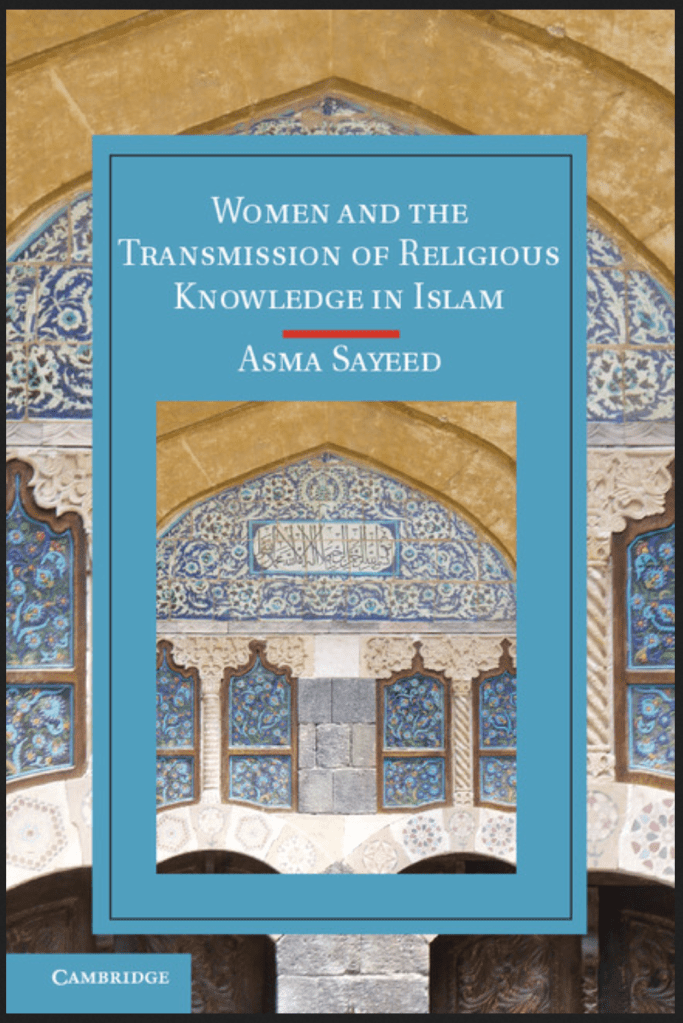
Image Source: https://i0.wp.com/lawandreligionforum.org/wp-content/uploads/2013/02/sayeed.jpg
Throughout the development of early stages of Islam (7th century CE), the role of women during that time is critical. Not only because it was a woman the first person to believe in the message of the Prophet Muhammad (PBUH, peace by upon him), but also because some women of that time became direct witnesses of events and sayings of Muhammad (PBUH). As a result, women turn into active references of oral transmission of events, which much later those sources and isnad (chain of transmissions) became known as the hadiths.[1] Women’s contributions in the transmission of hadiths are crucial for scholars of Islam who aim to portray a fair account of primordial developments of Islamic traditions. Female companions of the Prophet (PBUH) were direct witnesses to what he instructed and represented as a human being. Therefore, this close involvement later turned into sources for consultation after the passing of Muhammad (PBUH) especially in matters of marriage, fasting, pilgrimage, eschatology, and issues commonly deemed private, such as wife-husband responsibilities. What is even more notable is that compilers of the matn al-hadith (the hadith texts) have “enumerated between 1,500 and 2,400 hadith for which ‘Aisha [Muhammad’s wife] is the first authority.”[2] Consequently, the impact left by women companions is clearly reflected in the hadith, which constitutes a central source of the exemplars from Muhammad (PBUH) throughout his life as the recipient of the Qur’anic revelations.
[1] The example of the Prophet Muhammad (PBUH), sunnah, recorded in hadith, which establishes normative precedent for Muslims. It is considered the second canonic source of Islam after the Holy Qur’an.
[2] Asma Sayeed, Women and the Transmission of Religious Knowledge in Islam (Cambridge: Cambridge University Press, 2013), 25.
This essay aims to discuss the importance of Muslim women’s involvement in the development of early Islamic traditions, not only as direct witnesses but also as participants in such developments. Second, to provide a critical view of Western scholarship regarding evaluations on female hadith transmitters where, for instance, contemporary feminist discourses examine pre-modern texts that deal with women and gender using contemporary lenses. On that last point, I wish to stress that women’s involvement had a strong sign in building classic Islamic tradition and left a footprint for later generations, especially on authenticated hadith, which is the cornerstone of faith for many Muslims; evaluations on egalitarianism, misogyny, and/or feminism have no place within the 7th-century mindset. I intend to underline, beyond politics and/or gender-power analysis, that the female companions of the Prophet (PBUH) were, among men, strong voices to either ratify or rectify the Prophet’s sayings and deeds later detailed in the hadiths. Direct women companions, such as ‘Aisha (his last wife), were the vivid testimonial sources of those accounts. Under that premise, it is important to mention that reflections and notes are drawn from the Sunni tradition, not Shi’ites, where the latter group only recognizes its own authoritarian oral transmission coming from the family of the Prophet (PBUH) via Ali, whom they consider the first successor. Scholars such as Leila Ahmed, Kecia Ali, and Asma Sayeed will be cited to help underline, first, that I am not seeking comparative analyses on egalitarian conditions within the early Islamic tradition, as those circumstances were largely parallel to Mesopotamian and Mediterranean predecessors as well as contemporaries.[3] Said differently, egalitarian issues are not exclusively of Islam. Moreover, I wish to make clear that the participation of women during the early developments of Islam goes beyond the mere sexualization of this topic, which often appears as axiomatic in the Western academic world.
[3] I am not concerned with underlining same-old-cliché topics such as hijab, polygamy, or ‘Aisha’s age, which have been overused -mostly- as enticement to advocate controversies to suit particular target audiences. Instead, I intend to enlighten readers on getting a broader view of women in classic Islam within the cultural spectrum of that time.
American scholar of Islam Kecia Ali addresses the subject of the role of women in the transmission of hadiths from the relationship with Muhammad as well as his exemplary position as a model of a husband.[4] However, I find extensive use of modern terms such as ‘feminism’ and/or ‘feminists’ when (e.g.) she stresses that contemporary feminist scholars have “generally ignored hadith literature to focus exclusively on reinterpreting the Qur’an,”[5] especially some hadith that speak of women as inferior to men. Although this appears accurate, it is very rare cited by the general traditional legal field. As for the use of contemporary terms, such as those cited, to offer an analysis of hadith reports from the 7th century seems appalling to me. On that note, Professor of Islamic studies Asma Sayeed states that “feminism and feminist consciousness cannot be projected back to the premodern eras.”[6] I find that the scrutiny of hadiths to pinpoint specific notions of woman-man egalitarianism in the 7th century using 21st-century debates only showcases shortcomings from scholars of religion instead of setting analyses within a historical, societal, political, and cultural spectrum of the specific times scholars wish to scrutinize. In other words, using contemporary cultural-related terms to describe women in relation to men in the so-called premodern times only reflects how a scholar reveals her/his own consciousness toward the subject at hand. As per the topic of women as transmitters of knowledge, Sayeed clearly stresses that after Muhammad’s death, “men and women both contributed to an informal, unregulated exchange of information about him,”[7] and I find her remarks at the core of the historical narrative.
[4] Kecia Ali, “‘A Beautiful Example’: The Prophet Muhammad as a Model for Muslim Husbands,” Islamic Studies 43, no. 2 (2004): 277.
[5] Ali, “A Beautiful Example,” 276.
[6] Sayeed, Women and the Transmission, 265.
[7] Ibid.
Ali’s focus, among others, sets on the rather typical contemporary examinations such as ‘Aisha’s age, marriage and polygamy, sexuality, and (again) feminism. When it comes to stressing the importance of ‘Aisha and the transmission of hadith, Ali does offer prompt comments such as her role as “a major reporter of prophetic traditions and a jurist of some note.”[8] Other than those instances, Ali every so often returns to the usual Western-demanding subjects that feed controversies, which appears to accommodate a particular target audience. On that last note, I find intriguing that in her book The Lives of Muhammad Ali offers very resounding comparative analyses on how we observe different biographies of the Prophet (PBUH) throughout times when particular authors sought to provoke readers, especially under the tutelage of Western European colonial power.[9] The point remains in the contradictions behind that last statement and her own writings (e.g. in her book Sexual, Ethics, and Islam), where women in Islam appear to be reduced to what Western readers’ fixate: marriage, money, sex, divorce, and female bodies. There is a certain level of ambiguity when she, on the one hand, certainly addresses biases toward biographies of Muhammad (PBUH) while, on the other hand, her later writings on Muslim women are reduced to a sexualized image. Furthermore, Ali’s reflections center on the subject of early Islam and the impacts on women instead of the other way around, which is the question of how much impact women left through early stages of Islam, and that remains at the core of my argument. Rhetorically speaking, what’s more important, as an advocate of feminism myself, is the legacy that early Muslim women set in the development and transmission of Islam. However, and beyond my previous reflections, Ali offers a great insight when she reflects on how Westerners and Western intellectuals choose what they want to believe: “My experiences attest to the impotence of facts alone to change people’s beliefs,”[10] implying that facts alone are futile when it comes to changing what people choose to believe. However, I strongly stand behind the idea that, as scholars of Islam, we can only offer different perspectives instead of imposing a particular narrative.
[8] Kecia Ali, The Lives of Muhammad (Cambridge, Massachusetts: Harvard University Press, 2016), 155.
[9] Ali, The Lives of Muhammad, 27.
[10] Ali, 234.
Egyptian American scholar Leila Ahmed addresses two important figures over early developments of Islam, Khadija (first wife) and ‘Aisha (last wife) of Muhammad (PBUH). She highlights the significance of early converts to Islam being mostly women, “including women whose clans were fiercely opposed to Muhammad”[11] (PBUH). However, even when tackling their importance of either Khadija or ‘Aisha as role models for Muslim wives, just as Muhammad (PBUH) exemplifies the perfect husband as addressed by Kecia Ali, Ahmed often diverts those fundamental points to underline, for example, zina (adultery), Qur’anic verses on veiling and seclusion[12] and, as the cliché goes, the question of ‘Aisha’s age. Although a casual reader might not deem them irrelevant, on a closer look, a scholar of Islamic religion could notice that Ahmed is clearly writing for a particular target audience, Westerners, where subjects mentioned above are appealing. This is also noticeable in Ali’s writing, where she features ‘Aisha’s age and/or the question of consent raised from Western readers, followed by the usual apologetic responses that, in the end, will neither satisfy nor persuade knockers of Islam. In other words, although topics like this “have originally been raised in the context of anti-Muslim polemic,”[13] Muslims themselves have addressed them when seeking to understand the implications of the conduct of the Prophet (PBUH) for their own lives.[14] I find a clear Western-Eastern power balance where the former questions and the latter needs to offer apologetic responses. Something very interesting from Ahmed is the fact that some “women even questioned Muhammad (PBUH) on why the Qur’an addressed only men when women, too, accepted God and his Prophet.”[15] As it happened with other subjects, questions were followed by revelations of Qur’anic verses, and the inquiry resulted in Surah 33:35:
Surely [for] Muslim men and Muslim women, believing men and believing women, devout men and devout women, truthful men and truthful women, patient men and patient women, humble men and patient women, charitable men and charitable women, fasting men and fasting women, men and women who guard their chastity, and men and women who remember Allah often-for [all of] them Allah has prepared forgiveness and a great reward.[16]
In other words, the Qur’an, which is a direct message from God through the Prophet Muhammad (PBUH), explicitly addresses equality of responsibilities for men and women. In the end, if we consider the time frame in question, this was revolutionary for the 7th-century Arabian mindset. Ali makes additional notes-to-pages to underline that most of the women who raise the questions were anonymous, although some inquiries came from (of course) his wife Umm Salama and ‘Aisha.[17]
[11] Leila Ahmed, “Women and the Advent of Islam” Signs 11, no. 4 (1986): 672.
[12] Ahmed, “Women and the Advent of Islam,” 666.
[13] Ali, “A Beautiful Example,” 290.
[14] Ibid.
[15] Ahmed, 72.
[16] “Surah Al-Ahzab – 35.” Quran.com. Accessed January 7, 2025. https://quran.com/al-ahzab/35.
[17] Ahmed, 257.
What I find intriguing is not the queries per se but how open women were to ask none other than the Prophet (PBUH), which denotes not only an incredible level of confidence from women but also an outstanding sign of humility from Muhammad (PBUH). What that said, can we affirm that these interactions reflected all men-women interactions across that society? Of course not. It is noteworthy that diversities of action of classical Muslim women suffered the limitation of norms of their umma (community), just like in any other circle, where memory and preservation of its traditions were held at their highest. To a certain extent, one could claim that those closer to the Prophet Muhammad (PBUH) had ‘the upper hand’ as the Companions, especially his spouses. At the same time, some scholars favour “Muhammad’s wives to the exclusion of other women as reliable transmitters,”[18] which implies that by simply having seen the Prophet (PBUH) should not offer any special attributes. The distinctive and unique status as the Companion of Muhammad (PBUH) should not be connected to what nowadays is considered as ‘rights’ of women, especially when addressing the subject of early Muslim women as narrators of hadith. Ahmed underlines that “the legacy of Muhammad’s Companions who consulted women for traditions about the Prophet set important precedents for later jurists who may otherwise have been inclined to disregard such reports”[19] and the development of this legacy had little, if anything, to do with discussions about women’s rights as such. Again, what I see as profoundly important is the legacy of women toward the formation of the Islamic tradition instead of the minutiae of particular hadith.
[18] Sayeed, Women and the Transmission, 63.
[19] Ahmed, 73-74.
Professor of Islamic studies Asma Sayeed highlights the importance behind man-woman egalitarian statuses when referring to the Companions of the Prophet Muhammad (PBUH). However, she makes a clear distinction between the Islam of the times of Muhammad (PBUH) and the later classical Islam. For Sayeed, the emphasis remains on the hadiths and women who took part in the transmission of knowledge but also the broader questions, such as the lack of disagreements on validity or authoritarian hadiths from women within “the first two centuries of Islam that there was in the classical period.”[20] Sayeed appears more objective than Ali or Ahmed when she asserts on absurd contemporary notions of feminism that “projected back to premodern eras to explain the rise or decline of female hadith learning.”[21] Sayeed ponders how women “who were culturally and religiously restricted in their interactions with men negotiated a field of learning that placed a premium on direct contact and oral transmission between students and teachers.”[22] Furthermore, she emphasizes the differences between early and later roles in participating in the transmission of religious knowledge. If we look at this from another perspective, we might not be able to answer the question of “the authenticity of any of the hadith ascribed to women of earliest generations, [but] we can certainly arrive at conclusions about the perceptions that later generations had regarding female participation in the transmission of religious knowledge.”[23] In other words, it is only when written forms of transmission took over the oral narration of traditions where we can assert the importance of women as part of those transmissions.
[20] Asma Sayeed, “Gender and Legal Authority: An Examination of Early Jurist Opposition to Women’s Hadith Transmission,” Islamic Law and Society 16, no. 2 (2009): 118.
[21] Asma Sayeed, “Women as Transmitters of Knowledge” in The Oxford Handbook of Islam and Women, edited by Asma Afsaruddin (New York, NY: Oxford University Press, 2023), 265.
[22] Sayeed, Women and the Transmission, 12.
[23] Ibid.
What’s very interesting is to find how early to later historical ways of transmission extrapolate to the move from oral to written tradition. One can see the importance of the shift from oral-to-written transmission of knowledge, especially using isnad [24] to collect the sunnah. This radically changed the way tradition was passed through generations as the sunnah became embodied in written form. As a result, written forms of depiction of rituals, equally for women and men, gave birth to the emergence of formal academia, resulting in the professionalization of the field of Islamic studies. Therefore, the depiction of women as transmitters of sunnah is clearly reflected in isnad accounts, as the 4th century (or 10th century CE) sees the “reemergence of women with respect to developments in the field of hadith transmission, including the canonization of hadith collections and the growing acceptance of written transmission[25] and the decreased reliance on oral transmissions.
One of the most interesting notes I find in Sayeed’s assessments is her clear position on contemporary feminist discourses about Muslim women’s agency and the importance of situating historical context when “interpreting the significance of gender in premodern eras.”[26] The author warns about the risks of offering contrasting analyses about the portrayal of women from premodern eras as subjugated to cultural norms without any shades of grey. Moreover, “women’s agency expressed by a subversion of patriarchal norms is not a theme in the dramatic increase of Muslim women’s pious activism in the classical era. Rather, what was at stake was the faithful preservation of Muhammad’s legacy.”[27] Simply put, following community and hadith traditions was not only a sign of submission (Muslim) but also an indication to uphold them as a sign of personal fulfillment and choice. It is crucial to underline that, rather than trying to find with absolute certainty about the authenticity of hadith, Muslims aspire to find a high degree of possibility that a report not only fulfills the spirit behind those reports but “accurately conveys Muhammad’s views.”[28] This is an imperative proposal to academic scholars who offer comparative evaluations of women from premodern Islamic times using contemporary feminist rhetorics that label their submission as a sign of subversion of patriarchal norms or renunciation without a choice, leaving out any other considerations.
On a closer look, and always within the examination of women’s participation in the transmission of hadith, it is noteworthy to stress that we are leaving out a particular reflection about those who compiled the matn al-hadith (the compilers of the hadith), the men. Leaving aside whether or not some of the hadith authentically reflect what women really offered as part of the chain of transmission, I find it specifically important that the compilers did not appear selective to leave out women as a crucial part of these transmissions of traditions.
[24] The hadith literature is a sacred tradition and the key to this sacredness lies in isnad “chain of transmission.” An isnad contains a list of narrators who memorized and transmitted a hadith through a chain, that directly reaches all the way back to the sacred person of the Prophet (PBUH).
[25] Sayeed, “Women as Transmitters,” 266.
[26] Sayeed, Women and the Transmission, 18.
[27] Ibid.
[28] Ibid., 10.
References
Ahmed, Leila. Women and Gender in Islam: historical roots of a modern debate. London: Yale University Press, 2021.
——— . “Women and the Advent of Islam.” Signs 11, no. 4 (1986): 665–91. http://www.jstor.org/stable/3174138
Ali, Kecia. “‘A Beautiful Example’: The Prophet Muhammad as a Model for Muslim Husbands.” Islamic Studies 43, no. 2 (2004): 273–91. http://www.jstor.org/stable/20837344.
——— . Sexual Ethics and Islam: Feminist Reflections on Qur’an, Hadith, and Jurisprudence. London, UK: Oneworld Publications, 2016.
——— . The Lives of Muhammad. Cambridge, Massachusetts: Harvard University Press, 2016.
Sayeed, Asma. “Gender and Legal Authority: An Examination of Early Jurist Opposition to Women’s Hadith Transmission.” Islamic Law and Society 16, no. 2 (2009): 115-150. http://www.jstor.org/stable/40377988.
——— . Women and the Transmission of Religious Knowledge in Islam. Cambridge: Cambridge University Press, 2013.
——— . “Women as Transmitters of Knowledge.” In The Oxford Handbook of Islam and Women, edited by Asma Afsaruddin, 259–74. New York, NY: Oxford University Press, 2023.
 My Bookshelves

Leave a comment